Learning about states of matter is one of those big “aha!” science moments for elementary learners. Kids love watching ice melt, water boil, and air fill up balloons. All of these are real-world clues about solids, liquids, and gases. In this post, I’ll share ideas for your states of matter unit, but also cross-curricular ideas for reading and writing too.
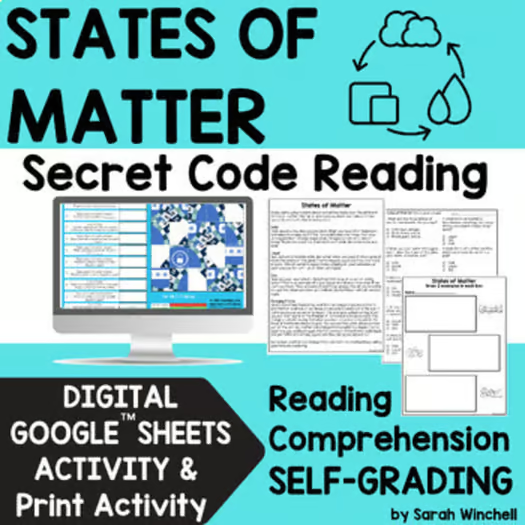
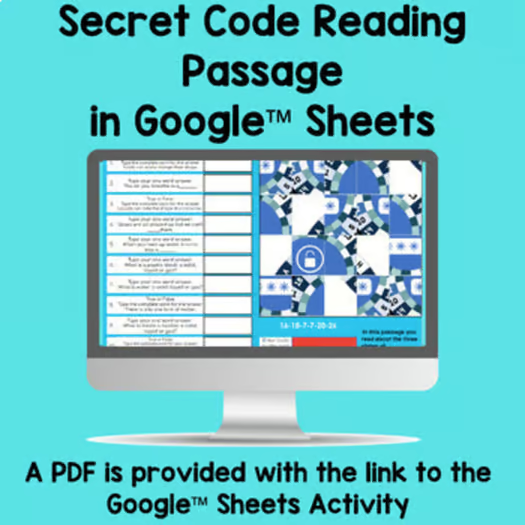
One excellent resource to anchor your unit is my States of Matter Secret Code Game. It combines informational text with a clever Google Sheets secret-code game and bonus printable activities. It’s perfect for literacy-rich science review. You can check out the details here:
What’s Included in This States of Matter Resource?
This States of Matter unit from Teachers Pay Teachers includes:
- A Secret Code Google Sheets Puzzle — students answer questions using text evidence from an informational passage to unlock the puzzle wheel.
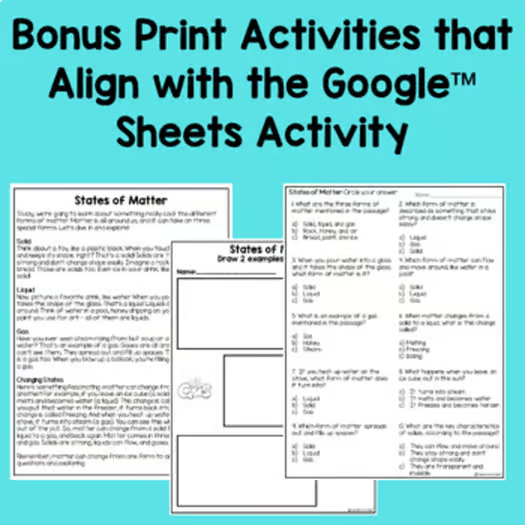
- Printable version of the passage for classroom reading.
- Draw & Connect worksheet — ideal for science notebooks or bulletin boards.
- 10 multiple-choice comprehension questions with answer keys.
- Teacher instructions and bonus activities.
- Key vocabulary like solid, liquid, gas, properties of matter, and changing states.
This makes it a versatile choice for morning work, individual practice, centers, group work, and science review.
5 More States of Matter Activity Ideas for 2nd & 3rd Grade
Of course, for your states of matter unit to be complete, you will need additional ideas. Here are some engaging activities that compliment my states of matter game and close reading passages:
Set up a Matter Sort Stations
Set up bins for solids, liquids, and gases using everyday items (rocks, water, balloons). Students can rotate through the station, recording where each object belongs. You might put a numbered sticker on each example and make it self checking by including a sorting checklist.
Interactive Exit Tickets
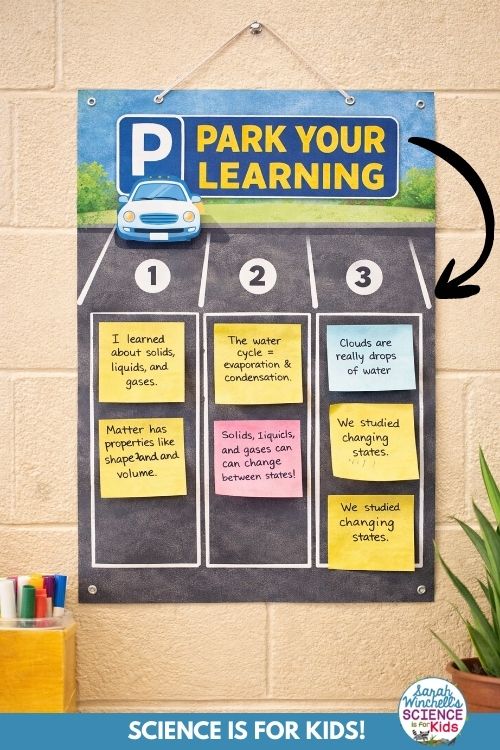
After reading the informational articles in the resource, have students write one new thing they learned about each state of matter on sticky notes. You can use a Park Your Learning poster like this and see exactly what your students need to learn yet and what they truly understand.
States of Matter Debate
Host a States of Matter debate. Divide your class into three teams, and then ask teams to defend why their assigned state of matter is the most important (e.g., “Solids never change shape!”). Have them meet and brainstorm all of the best traits about their state of matter. As they discuss, encourage them to work in important vocabulary related to the unit.
Science Notebook Sketches
Use the Draw & Connect worksheet from my unit as a springboard. Have students sketch transitions (ice → water → steam) and label what changed. Kids love drawing, and this activity can also lead to written elaborations related to the drawings. Plus, interactive notebooks work very well as a review for the test.
Classroom “Matter Museum”
Transform student work into exhibits. Include passages, drawings, experiments photos, and labeled object samples. You might have students prepare their exhibit and offer explanations to their peers about their work similar to a science fair.
Popular States of Matter Books to Support Your Unit
Reading aloud helps students better understand science concepts, and you can also use picture books to expand your unit concepts. Here’s a list of titles I’ve found for second and third grade. You might pull them together and have a bin of books for the kids to look at in your classroom library space.
- Matter — Darlene R. Stille
- What Is Matter? — Alexandra Hanson-Harding
- Matter: Physical Science for Kids — Andi Diehn
- All About Matter — Mari Schuh
- Matter Comes in All Shapes — Jodie Shepherd
- Curious Pearl Explains States of Matter — Eric Braun
- States of Matter (DK Super Readers, Level 1) — DK
- The Solid Truth About States of Matter — Agnieszka Biskup
- What Is the World Made Of? All About Solids, Liquids, and Gases — Kathleen Weidner Zoehfeld
- Change It! Solids, Liquids, Gases and You — Adrienne Mason
- Solids, Liquids, Gases, and Plasma — David A. Adler
Simple, Safe Experiments for the States of Matter
Hands on = minds on! These experiments help students see states of matter in action:
1. Ice Cube Observations
Time how long it takes ice cubes to melt at room temp vs. in the sun. Have students record what state transitions they observe. You can make a schedule for students to rotate through and document their observations.
2. Ice Excavation
Freeze small toys in a block of ice. Provide salt, water, and droppers. Students explore how solids melt into liquid and record results. Students can record how quickly the ice melts when salt is added.
3. Water Cycle in a Bag
Seal water in a Ziplock bag and tape it to a sunny window. Students see evaporation and condensation happen. After a few days, have students measure the remaining water to compare to the starting day.
4. Crystallized Snowman Magic
Use Borax and pipe cleaner shapes to grow crystals — a liquid turning into a solid structure. This is one of those memorable experiments your kids will love.
5. Ice Cream in a Bag
Add all of your ice cream ingredients to a Ziplock bag, and place it inside of a coffee can. In the can, surround the ice cream bag with ice and salt. Then shake it! (the kids love this part) This demonstrates melting and freezing in one delicious experiment! Plus, they can eat the ice cream later.
Closing Comments for Your States of Matter Unit…
The most important thing with any science unit is to make it fun and memorable and to teach it for deep understanding. Here are a few thoughts I’ll leave with you.
- Blend literacy and science. Let students annotate passages, highlight key vocabulary, and make predictions before reading. After reading, use summaries to pull concepts together.
- Use real world examples: Talk about puddles, steam from a kettle, and air in balloons to connect concepts. The more we can attach states of matter to real world examples, the easier it will be for students to recognize matter is all around us.
- Make activities student-led: Let small groups present their matter observations to build oral communication skills while also building upon reading and writing too.
- Differentiate with choice: Offer both oral and written responses for students who need accommodations. You can scaffold instruction by using text sets that are at a variety of reading levels.